
Morocco: Eight Nights Through the Kingdom of a Thousand Kasbahs
A self-funded journey through Marrakech, the High Atlas, the Sahara, Fez, and Chefchaouen.
There's a moment on the drive out of Marrakech, somewhere past the last roadside argan oil stand, when the High Atlas Mountains come into full view and you realize the trip you thought you were taking is about to become a much bigger one. Morocco has a way of doing that — every region feels like its own country, stitched together by mountain passes and long, beautiful drives.
I built this itinerary myself, flew it myself, and paid for every night of it myself — eight nights across five regions, with one private driver-guide the entire way. No comps, no press trip. Just the trip I'd send a client on.
Marrakech: The Overture
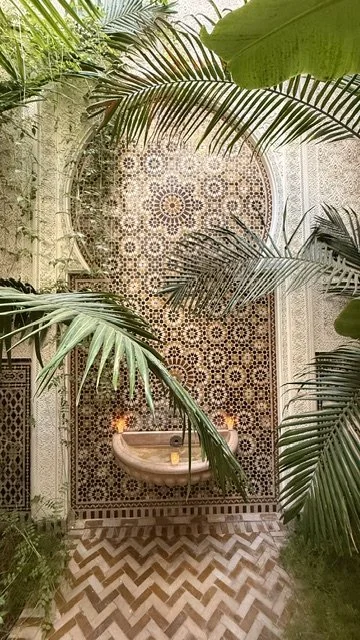
Every Morocco trip should start in a riad in the Marrakech medina — not a hotel, a riad. These are centuries-old courtyard homes, often just a handful of rooms, built around a fountain or a citrus tree, with rooftop terraces that catch the call to prayer echoing across the old city at dusk.
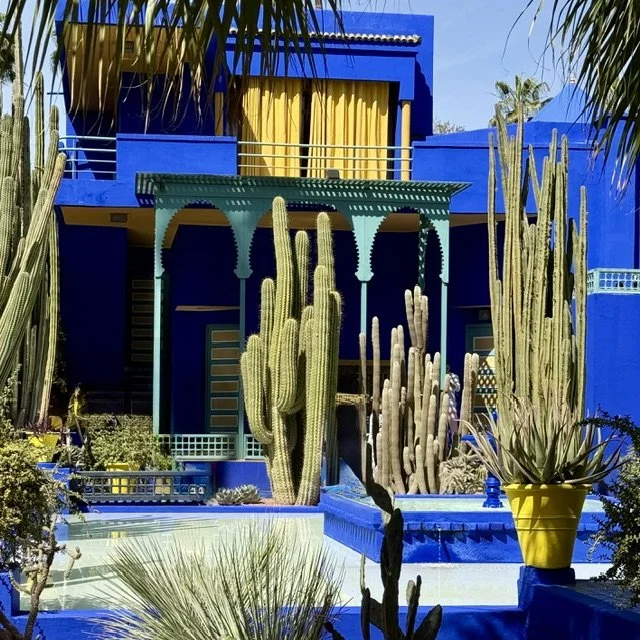
Mornings meant breakfast up there, watching the medina wake up below. Days meant a private guided walk past the Koutoubia Minaret and the carved cedar of the Madrasa Ben Youssef, getting pleasantly lost in the souks, tracking down Jardin Majorelle's cobalt blue walls, and standing in the middle of Bahia Palace's tilework trying to take in how much of it was done by hand. Then one day left fully open — a hammam, a cooking class, no agenda.
The Road South
The drive from Marrakech across the Tizi n'Tichka pass — switchbacks climbing past 7,000 feet — is, on its own, worth the trip. Kasbahs cling to hillsides, the landscape changes by the hour, and lunch happens at Ait Ben Haddou, the UNESCO-listed mud-brick fortress town that's played a stand-in for Lawrence of Arabia and Gladiator. From there the road continues through Ouarzazate, Skoura, and the Road of a Thousand Kasbahs into the Rose Valley. We overnighted in the Dades Gorge, where the valley opens into extraordinary rock formations, before continuing toward the desert.
The Sahara
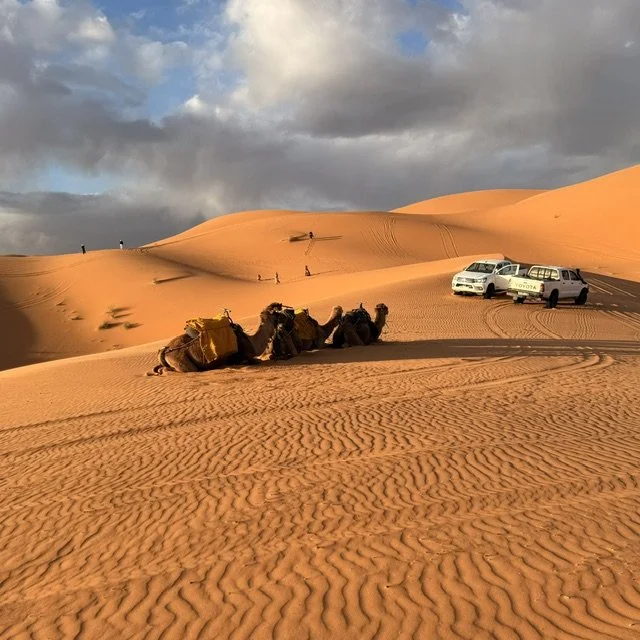
This was the part everyone who saw my photos asked about first, and I understand why. The route to Merzouga passes through the Todra Gorges and old mud-built Berber villages before arriving as the light goes gold. Climbing onto a camel for the walk into the dunes, then watching the sun set over a landscape that looks almost unreasonably beautiful, resets your sense of scale entirely. We spent the night in a luxury eco desert camp under a genuinely stunning number of stars — I'd go back for that night alone.
Fez: The Old Heart
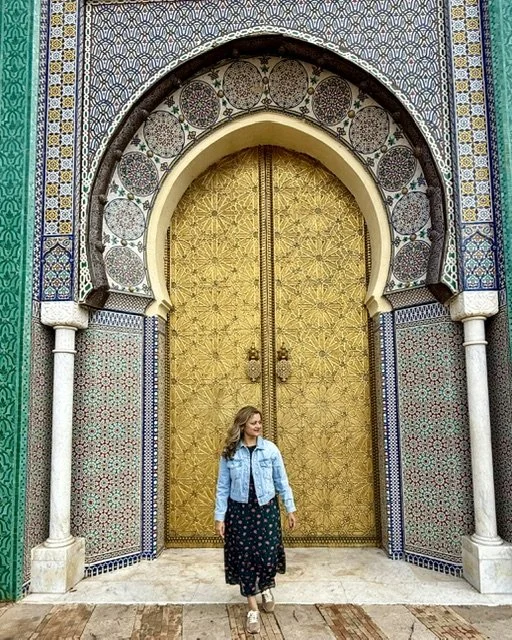
If Marrakech is Morocco's showpiece, Fez is its soul. The drive north passes through cedar forest cool enough for Barbary macaques to make a roadside appearance, and the alpine town of Ifrane, before arriving in a medina that is the oldest and most intact in the world — no cars, just a labyrinth of alleyways that have functioned exactly this way for a thousand years. A private walking tour covers the 14th-century medrasas, the Seffarine Square coppersmiths, the tannery views, and the Qarawiyyin, often cited as the oldest continuously operating university on earth.
We stayed at Riad Fès, Relais & Châteaux, which quietly turned out to be the single most luxurious hotel of the entire trip. The rooms, the courtyards, the level of craftsmanship — it's the kind of property that makes you understand why people fall for this country.
Chefchaouen: The Blue City
A detour north into the Rif Mountains brought us to Chefchaouen, where every wall, doorway, and staircase is painted some shade of blue. It's a slower, quieter stop after the intensity of the Sahara and the medinas — good for a night of just wandering with a camera and no real agenda, with a stop at the Kasbah museum and Uta el Hammam square along the way.
Casablanca: The Send-Off
Casablanca isn't a destination so much as a graceful way to end the trip — a comfortable final night before an early flight home.
Why This Trip, Why Now
Morocco offers something increasingly rare: a destination that feels genuinely transporting — desert, mountains, medieval cities, Atlantic coast — without the price tag of comparable trips in Europe or East Africa. It rewards a little flexibility, whether that's in timing or how the days are routed, and it pays that flexibility back many times over in the experience itself.
If Morocco has been sitting on your list, I'd love to help you build the version of this trip that fits you — family-friendly, honeymoon, multi-generational, or exactly the loop I did. Reach out and let's talk through it.
Frequently Asked Questions
How many days do you need in Morocco for a trip like this?
Eight to nine nights is the sweet spot for the full diagonal route through Marrakech, the High Atlas, the Sahara, Fez, and Chefchaouen, without feeling rushed. It can be compressed to six or seven nights by trimming a free day in Marrakech, or extended with a coastal add-on in Essaouira.
Do I need a private driver, or can I get around Morocco on my own?
A private driver-guide for the full route is the single biggest quality-of-life decision for this trip. Distances are long, road conditions vary sharply between regions, and public transit does not connect these stops in any reasonable way. A private driver also allows for flexible stops along the route that a fixed bus tour would skip.
Is one night in the Sahara enough?
For most travelers, one night in a desert camp is enough to experience arriving by camel at sunset and waking for sunrise over the dunes. Travelers with more flexible timelines sometimes add a second night for a deeper stay, but it is not necessary to feel the full impact of the experience.
What's the difference between staying in a riad versus a hotel?
A riad is a traditional courtyard house, usually converted into a small guesthouse with just a handful of rooms, built around a fountain or citrus tree with a rooftop terrace. Staying in one, particularly in Marrakech and Fez, places travelers inside the medina itself rather than outside it, and tends to offer a more intimate, personal experience than a standard hotel.
Is Morocco a good destination for a first trip to North Africa?
Morocco is one of the more accessible entry points into the region for first-time travelers: safe, well set up for tourism, close to Europe, and varied enough that a single trip covers desert, mountains, medieval cities, and coastline.
When is the best time of year to visit Morocco?
Spring, from March through May, and fall, from September through November, are the strongest windows, with mild temperatures in Marrakech and the desert and good conditions for the mountain passes. Summer brings intense heat to the Sahara and southern regions, while winter nights in the desert and High Atlas can be quite cold.
Ready to plan your own version of this trip? Get in touch and let's build your itinerary.